
Systems neuroscience applied to understanding the internal states governing anxiety and traumatic experience. Development of new treatments such as novel serotonergic neuroplastogens for anxiety and PTSD.
Lab is located in the Yale University Department of Psychiatry.

Neuromodulatory encoding of threat
The experience of trauma can profoundly alter perceptions of safety and emotional dynamics. We attempt to understand this process at multiple levels using optical and electrophysiological approaches in concert with computational modeling of threat perceptions. We are particularly interested in the interplay of innate and learned threats, and in the role of norepinephrine circuits in computing threat prediction errors.

Novel pharmacological treatments for PTSD
More effective pharmacological treatments are sorely needed for PTSD, which has a substantial lifetime burden of disability throughout the population. Recently, serotonergic agents such as MDMA, psilocybin and a multitude of related psychedelic compounds have shown promise for PTSD. We are interested in understanding the mechanisms of action of these drugs, and how they may alter circuit mechanisms of PTSD.
Developing circuit biomarkers for anxiety and PTSD
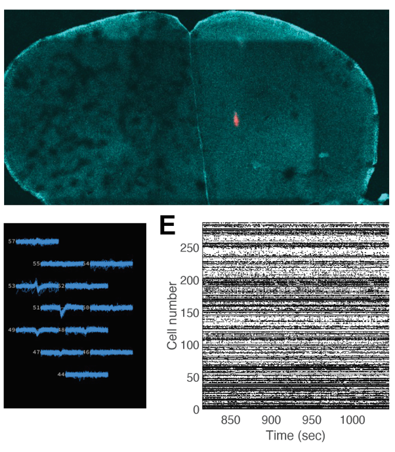
As neural circuit techniques have advanced, it has become possible to understand the basis of more complex forms of behavior. Understanding how neural ensembles represent danger is a critical next step for systems neuroscience. As part of a study funded by the Wellcome Trust, we record neurons throughout emotional brain circuits to understand those brain states. By doing so, we can develop a deeper understanding of the links between circuits and internal states, and develop actionable biomarkers for anxiety.

Tools:
Microendoscope calcium imaging, 2-photon imaging
Neuropixels
Fiber photometry of neuromodulator biosensors
Computational modeling of behavior
Computational modeling of psychiatric disorders
Collaborations involving intracranial EEG in humans